
Sections55 parts
- 01How I adapted the story
- 02Adapting the story to what I could produce
- 03The story in five sections
- 04What the audience needed to understand
- 05The folder structure behind the film
- 06A stable identity for each scene
- 07Keeping decisions separate from attempts
- 08Finding the characters and their world
- 09Character identity needs more than one attractive portrait
- 10Locations carry continuity too
- 11Planning the action before generating a shot
- 12Developing the opening inside Higgsfield
- 13A real prompt unit: the café family
- 14Camera alternatives were not consecutive shots
- 15Where Blender helped me resolve the staging
- 16A camera test with static performers
- 17Keeping the Blender scene editable
- 18Giving each reference a specific role
- 19The reference roles
- 20Recording the movement myself
- 21Returning to the scene’s existing prompt
- 22Choosing the scope of a correction
- 23What went wrong in the hospital and opening shots
- 24A continuity problem that had a different solution
- 25How I worked with agents
- 26Finding voices that could carry the performance
- 27Correct words, wrong performance
- 28A reference I selected, followed by auditions I rejected
- 29Repairing a phrase inside an existing take
- 30The separate question of language and signing
- 31Building the soundtrack one scene at a time
- 32Mapping sounds to visible actions
- 33Auditioning individual sound sources
- 34Making room for silence
- 35Moving from everyday warmth to the accident
- 36Bringing the film together in DaVinci Resolve
- 37Section timelines and the full-film assembly
- 38Watching what happened across a cut
- 39Checking the result of a scripted edit
- 40Turning earlier scenes into a wall of memories
- 41From a camera guide to a finished insert
- 42Narration gave the camera its destinations
- 43Finding the right amount of reflection
- 44Making the previous scene become a photograph
- 45Subtitles, credits, and the submitted version
- 46Designing the last sequence
- 47Missing subtitles and the limits of a timeline check
- 48Identifying the submitted export
- 49What I kept for future revisions
- 50What the production actually involved
- 51Time and money had different measurement boundaries
- 52What I would carry into the next film
- 53The scene information I would keep
- 54A demanding scene as the first complete test
- 55What I would review first
ISA follows a Brazilian girl whose childhood encounters with care and a communication barrier shape her later work in education and conservation. For this AI-assisted short film, I organized the story into five sections and 24 production entries, combining generated clay-inspired imagery, Blender camera studies, voice and sound production, and editing in DaVinci Resolve.
The submitted film runs approximately 7 minutes 25 seconds. Its ending reuses earlier images and videos as photographs on a moving-camera board. This making-of follows the production from story and folders to that final sequence, delivery, and editable archive.
I use finished scenes, discarded takes, and motion and voice tests to explain the choices behind the film.
1. How I adapted the story
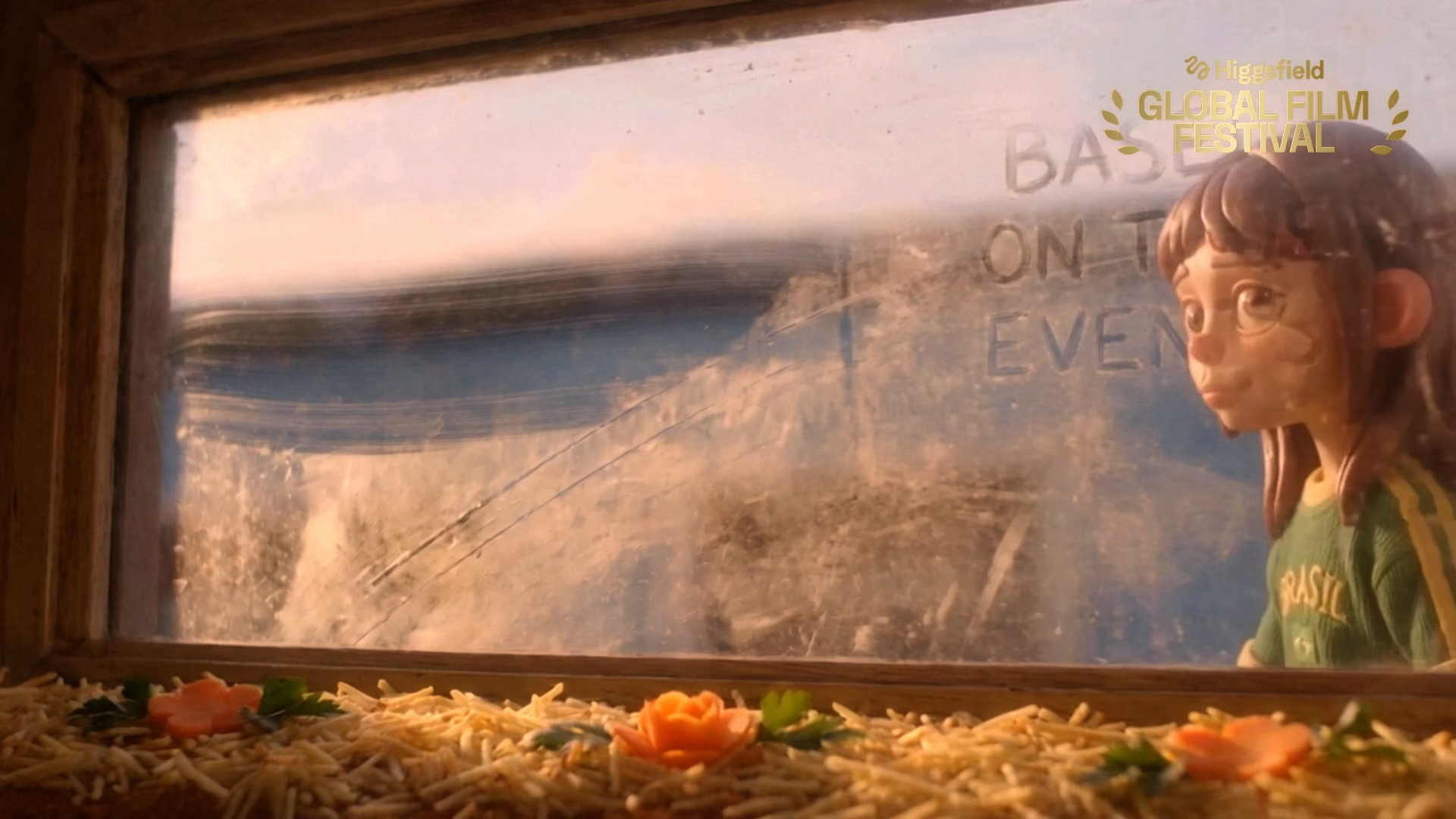
The hospital experience connects the story. Isa’s parents are deaf, and she moves between spoken Portuguese and Libras, Brazilian Sign Language, during her mother’s emergency. Her father’s insistence and the crowd’s response become experiences she carries into her own choices to help others.
The starting material was a biographical story rooted in Minas Gerais, Brazil. For an international short-film audience, I selected episodes that could communicate through action and connected them through Isa’s growing willingness to help.
The adaptation used fictionalized characters and generated voices. The narrative records separated documented history, dramatic compression, and projected future material; generated images needed to respect those distinctions.
Adapting the story to what I could produce
I started with a story in mind, but it changed as I learned what the generation tools could deliver. Some actions and performances were difficult to get consistently. I had to simplify parts of the story and change how I presented them so the film would work with the material I could produce.
With roughly US$300 available for subscriptions, I had limited room to explore variations. I could not keep generating every nuance or alternative until it matched the version in my head. The budget shaped how much I could experiment and when I needed to adapt an idea to finish the film.
I kept each scene’s purpose even when I changed the action used to communicate it.
The story in five sections
| Narrative section | Story material | Production question |
|---|---|---|
| Childhood and the street | Family, storefront, accident, immediate response | Can the viewer follow the people, their positions, and the cause of the disruption? |
| Hospital | Communication barrier, family support, institutional pressure | Can the audience understand who needs help, who understands, and why the next action happens? |
| Library and turtles | Helping other people and participating in conservation | Does Isa’s choice read through action rather than explanation alone? |
| Travel and mentorship | New places, learning, encounters with others | How do these episodes remain connected to the same person and story? |
| University, ending, and credits | Teaching, continuation, reflection | What does the audience carry away, and how does the film close without claiming every problem is solved? |
The screenplay held the action, spoken lines, signed intent, and subtitle requirements; the scene prompts translated those decisions into framing and performance. That separation mattered whenever a line changed: the change also affected the audio request and captions, not just the next image prompt.
What the audience needed to understand
The storyboard method tracked what the audience needed to understand, what information to withhold, and the spatial and emotional relationships between characters. This gave me a way to judge a shot beyond whether it looked good.
For a scene involving communication, that can mean preserving a face, both hands, shoulders, and the space in which someone signs. A close-up that looks attractive may remove the action that makes the scene intelligible. For a street interaction, the critical information may instead be the relationship between a child, a doorway, a vehicle, and another person’s line of sight.
ISA initially had a roughly five-minute target. As the scenes found their timing in the edit, the film grew. The useful question became how much time each action and consequence needed to read.
2. The folder structure behind the film
I needed to return to a scene and find its current sources, previous attempts, and next decision without reconstructing everything from a conversation. This abbreviated map shows ISA’s working responsibilities after several organizational revisions.
ISA/
  Story/
  Assets/
  Production/
    Acts/
    Visual/
    Requests/
    Receipts/
    Operations/
    isa_shot_register.md
  Audio/
  Shots/
    Review/
    Approved/
  Edit/
    Resolve/
Exports/| Location | What it owns | Why it stays separate |
|---|---|---|
Story/ |
Screenplay, character and environment bibles, production direction | A prompt revision should not silently change the story or visual rules. |
Assets/ |
Shared characters, locations, references, source material, and previs | Several scenes can use the same identity or location without creating competing copies. |
Production/Acts/ |
Scene entry points, scene-local prompts, references, and media links | The work for a scene can be found together. |
Production/Visual/ |
Per-shot visual decisions | A chosen camera or composition has a record beyond a chat message. |
Production/Requests/ and Receipts/ |
What was requested and what an operation returned | An intended result and an actual output can be compared. |
Audio/ |
Dialogue, narration, music, effects, ambience, and supporting records | Sound can be revised and reviewed independently of picture. |
Shots/Review/ and Approved/ |
Candidates and selected material under their recorded status | A successful download does not automatically become a selected shot. |
Edit/Resolve/ and Exports/ |
Editable assembly and rendered versions | A movie file and the project needed to revise it are different deliverables. |
A stable identity for each scene
Scene work lived under a section and shot identifier, such as Production/Acts/01_ACT_I_Storefront_Accident/S01_SH030/. Its README linked the relevant prompts, references, media, and canonical story. That ID remained useful when a prompt or candidate changed.
The 24 entries were production units, not a count of shots in the submitted edit. For example, the storefront entry combined several generated source clips. I kept that distinction between a story scene, a camera shot, a generated clip, and the register entry used to organize the work.
The scene ID connected an experiment to its shot, while the scene record carried the selection decision. A higher version number did not necessarily mean a better or selected take.
Source identity mattered again during editing. A readable scene name helped me navigate, but Resolve also needed to find the original media. Renaming a provider file without preserving that relationship could break a relink.
Keeping decisions separate from attempts
ISA’s organization changed during production. Scene-local prompt ownership, Markdown visual cards, and links to shared references made navigation clearer. Historical central requests and older prompts were retained as evidence of earlier work rather than treated as interchangeable current instructions.
The shot register linked current decisions to specific candidates. A rendered or downloaded file stayed under review until selected; folder names alone did not establish approval.
The part of this structure I would reuse first is small: a scene card, its source list, and a review note. The larger request and automation system made sense for repeated operations; it was not a prerequisite for starting the film.
3. Finding the characters and their world
I wanted ISA to feel like a photographed miniature world: clay-like faces, real-cloth cues, handmade edges, small surface irregularities, and lighting that preserved the materials. It was an AI-generated visual direction, not a physically fabricated stop-motion production.
In the production bible, I described weight, contact, deliberate poses, and restrained timing irregularities. Lowering the frame rate of smooth movement would not create those physical qualities.
Character identity needs more than one attractive portrait
The character references established face shape, proportions, clothing, materials, and distinguishing features across views. They also had to account for Isa appearing at different stages of life. A scene could change pose and camera while still needing the viewer to recognize the same person.
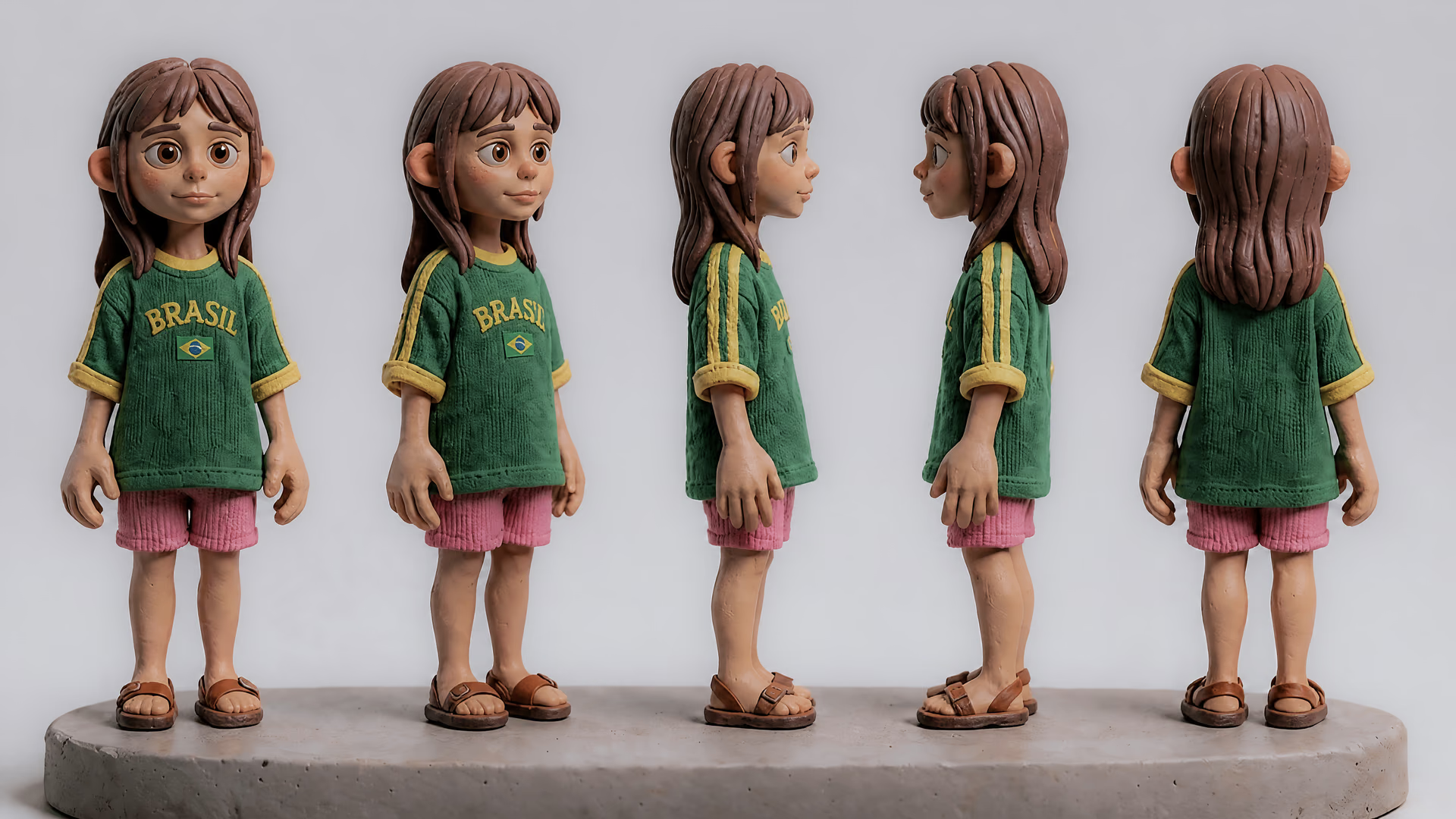
This was the concept I used for young Isa: clay-like features, a green Brasil shirt, pink shorts, and brown sandals. The five views established her proportions, silhouette, clothing, and materials. Her acting and camera direction still needed to be defined for each shot.
Locations carry continuity too
The environment bible defined grounded Brazilian daylight for the city, practical fluorescent light for the hospital, and tactile warmth for education and community scenes. The hospital was not supposed to drift into horror grading. These choices affected the story’s tone as much as its surface appearance.
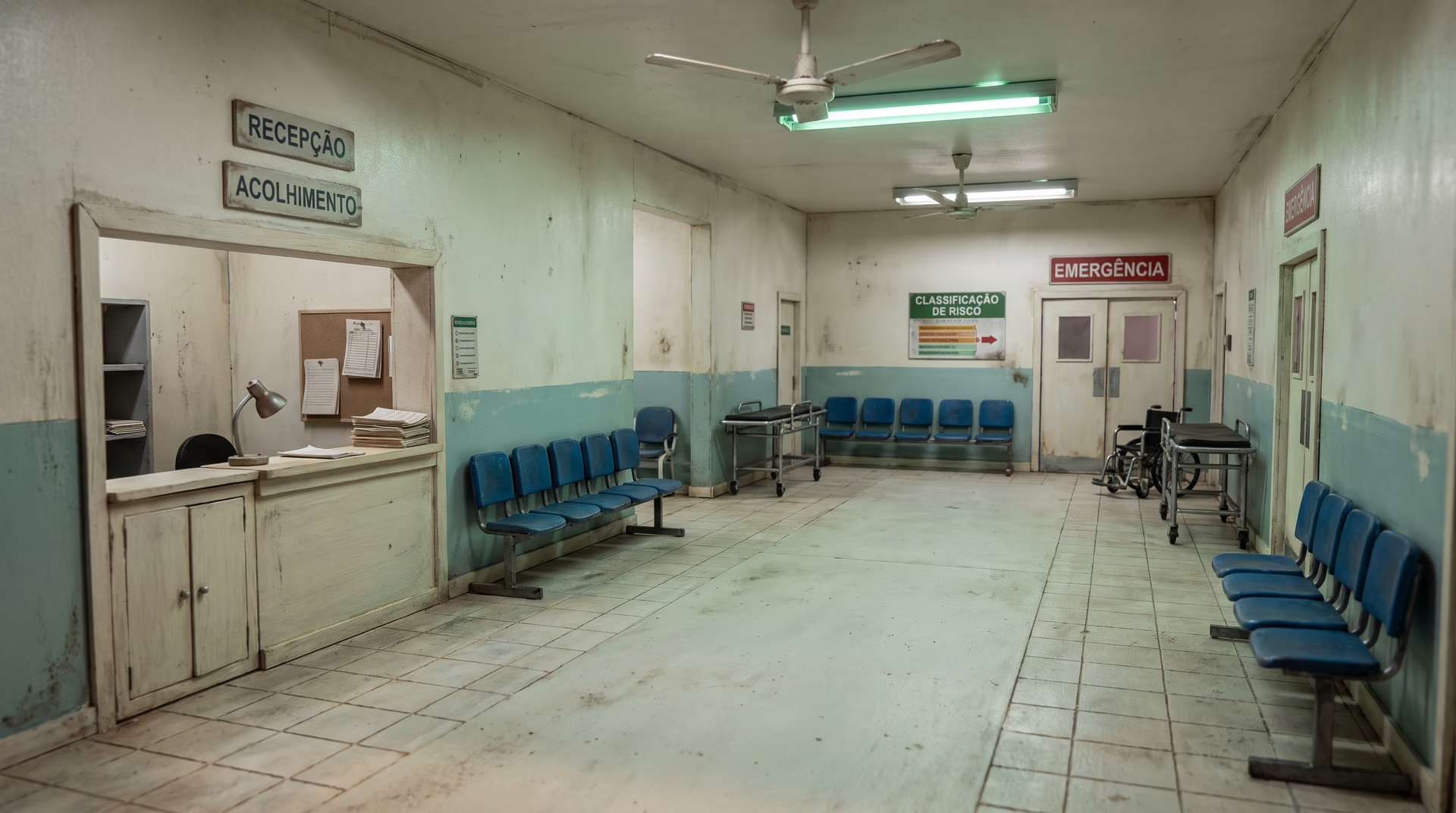
This Higgsfield candidate moved the waiting chairs against the walls to open a continuous route between reception and emergency. Its layout was retained for further study, while camera height still needed review. The layout question was practical: where would the family enter, where would the staff member sit, and could someone cross without blocking the exchange?
The location reference supplied architecture, furniture, paths, landmarks, and light. Its overview camera or incidental people could conflict with the intended shot, so each reference needed an explicit role.
Reverse angles raised another continuity problem: a convincing new view could still contradict the room already established. For a future project, I would settle the main action area and its reverse view earlier.
4. Planning the action before generating a shot
The difficult shots taught me to separate staging from finish. A polished image could still put the wrong person in the wrong place, leaving the action unreadable.
I used different kinds of preparation for different questions: boards for the progression of an action, timing studies for its duration, and Blender for spacing and camera movement.
A simple scene may need only a few key beats. The accident, hospital exchange, signing, and board reveal justified more preparation because their action or geography was harder to communicate.
Developing the opening inside Higgsfield
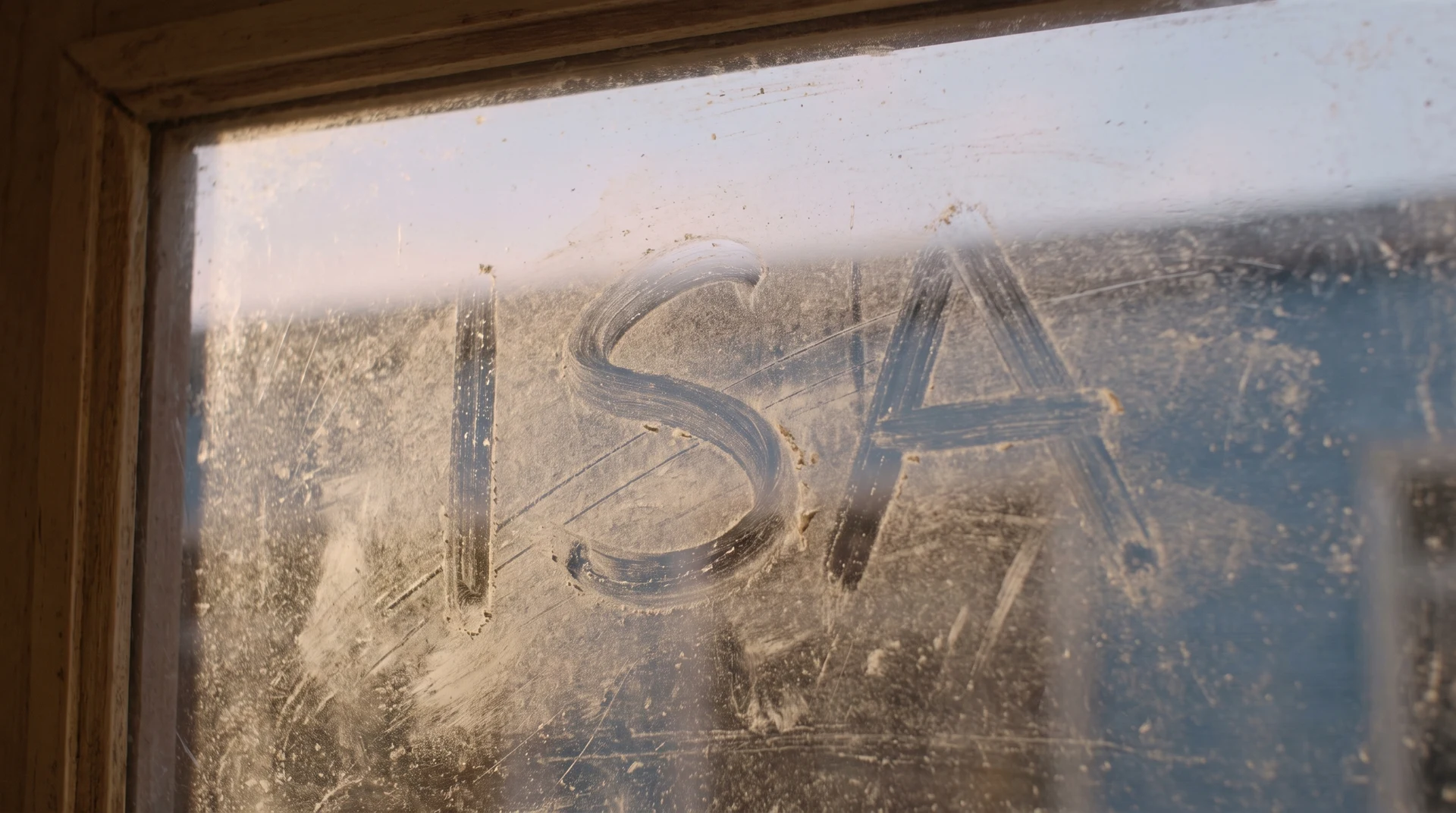
The Higgsfield keyframe plan separated the opening into four states: the title on dusty glass, the wider storefront reveal, Isa making a broad hand wipe, and the final hold with her gaze toward the pie. Each new frame needed to preserve the same environment, camera relationship, pie scale, and character identity.
The title frame generated with Nano Banana Pro was selected as the opening reference. The wider candidate illustrates a rejected iteration, not the next approved frame. Both are retained outputs from the ISA Higgsfield project.
Selected title reference
Rejected wider candidate
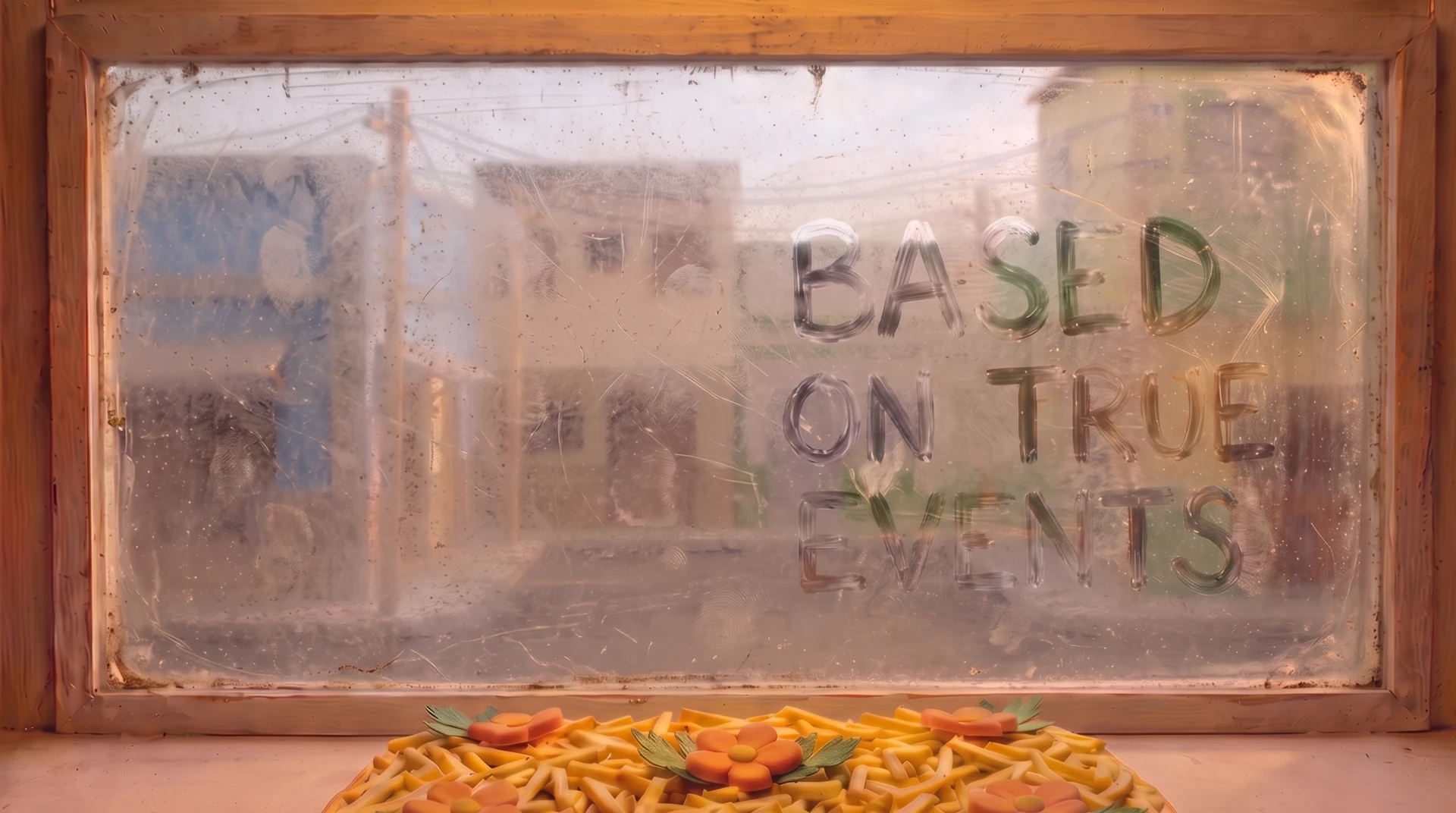
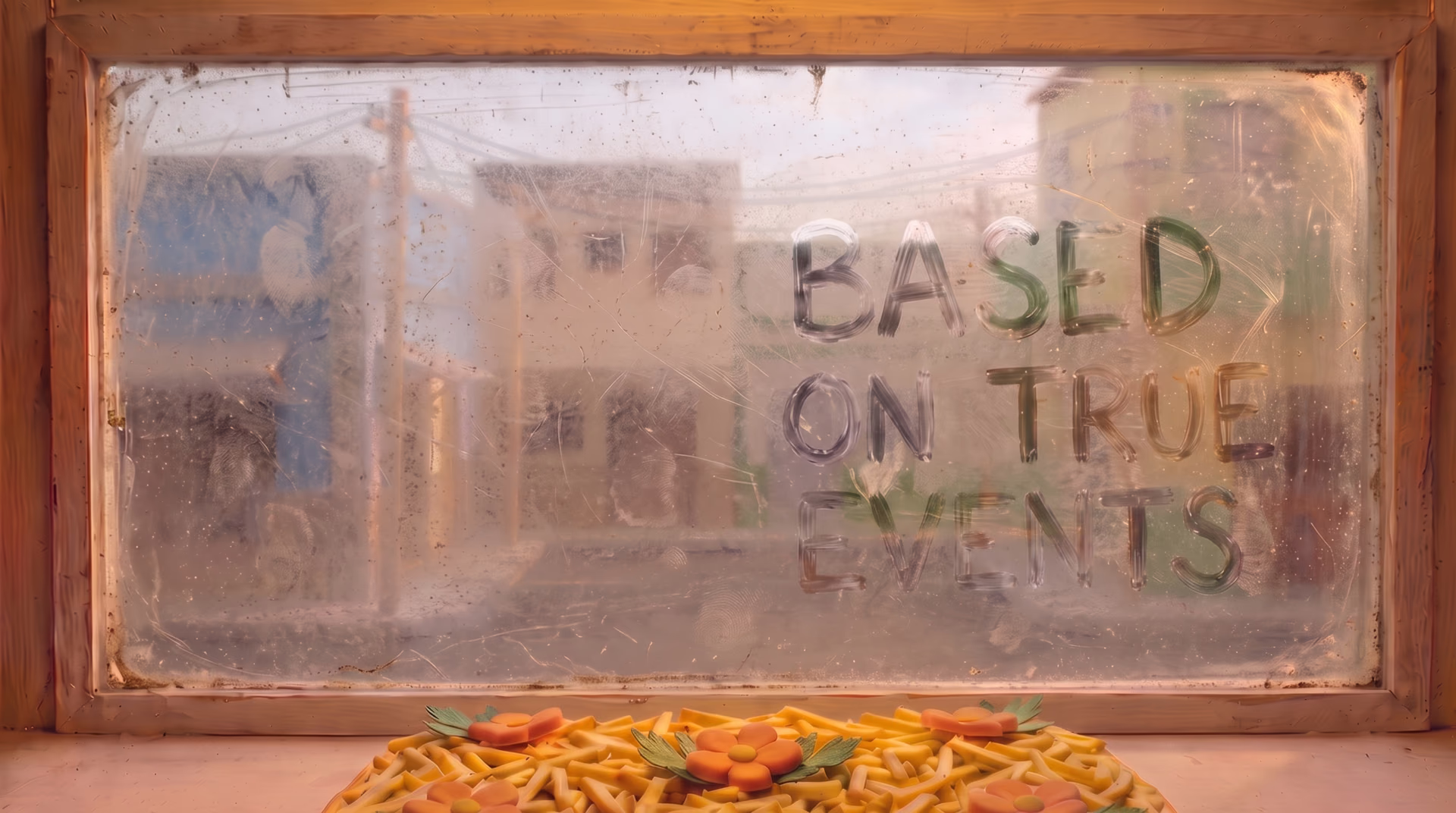
The wider attempt flattened the pie into a strip, made the lettering look engraved, and exposed too much exterior. I rejected it because it changed the intended relationships. Those failures had to be resolved before the image could support a continuation. Getting an output back from the model did not make it usable.
A real prompt unit: the café family
The café-family prompt provides a compact example of shot preparation. It used a location reference for the architecture and daylight, and a separate family reference for four distinct people. These were the café family, not Isa’s family.
The camera was a locked medium view at the table. The prompt assigned the father, mother, and two daughters to specific identities and positions. It divided the ten-second request into three periods:
| Time | Intended action |
|---|---|
| 0–2 seconds | Four people are already seated; the father engages with the two daughters while the mother attends from opposite him. |
| 2–7 seconds | The daughters respond with gestures and laughter; the mother laughs with them. |
| 7–10 seconds | The group sustains its interaction without noticing the offscreen mother from Isa’s story. |
I requested café and street ambience, laughter, and table Foley, without intelligible dialogue.
The café request kept the camera locked and the cast already seated, concentrating the test on one interaction. That made the intended performance easier to describe than a request that also had to establish everyone’s arrival.
Camera alternatives were not consecutive shots
Several camera options may describe the same action. They are not automatically consecutive events. If one version shows an approach from the front and another from the side, placing both into a generation request can cause the model to repeat the action or invent a transition.
This was also why a narrow correction needed to preserve the chosen variant. A camera revision could otherwise quietly replace the cast, the starting position, or the action I was trying to retain.
5. Where Blender helped me resolve the staging
Blender was useful when the uncertainty was spatial: where people stood, what the camera could see, how a vehicle or stroller moved, and whether a transition passed through the set.
The board used 24 fps, so a two-second transition occupied 48 frames. That relationship is specific to its time base. In another project I would establish the edit’s frame rate and aspect ratio before the camera study, and preserve each source image’s proportions when sizing the cards.
The previs used simple proxies. Detailed characters would have increased the work without necessarily making the camera decision clearer. Colors and shapes distinguished roles, while the location supplied the geometry needed for contact, scale, and movement.
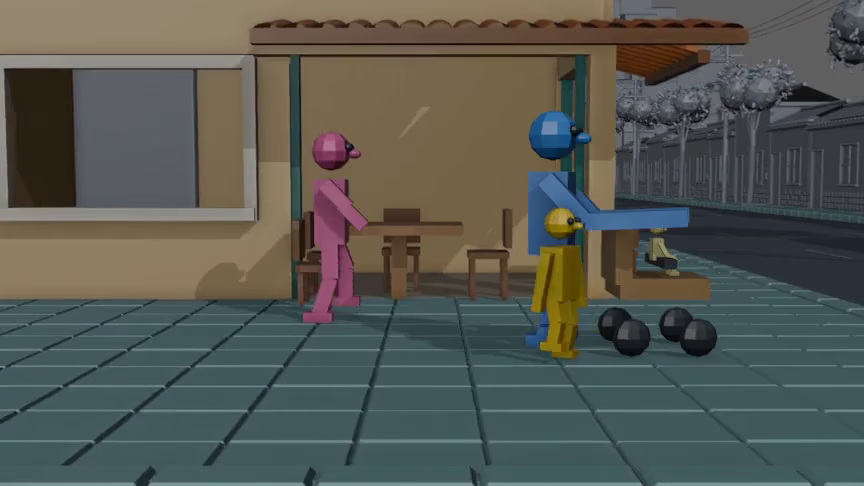
Those proxies needed explicit mapping in the generation handoff. A blue figure might be Isa in one study, but color alone could not establish that identity for every scene. Each visible proxy needed to be connected to its intended person or prop, including its position, facing, and motion. The final appearance came from the character references.
This preparation was not consistently right on the first attempt. In the street work, I rejected unclear stroller and family placement and asked for the proposed blocking in writing before another pass. Other corrections addressed intersecting characters and timing. In a separate concept review, I asked for gray composition studies after polished alternatives got the car and family trajectories wrong. Reducing the visual finish made the actual staging problem easier to judge.
A camera test with static performers
A turtle-lesson study isolated a ten-second camera approach toward a group. The camera moved while the proxies stayed in place. That made it possible to judge the approach and group arrangement before attempting the final acting.
In this reference, blue represented Isa, purple the mother, green the boy, four small red figures the other children, and the large red figure an adult. These were production labels, not the final clothing or skin colors.
I selected this study as a camera reference for the lesson prompt. The proxies stayed still, so I still needed to work out the characters’ movement, contact, eyelines, and gestures in the generated performance.
Keeping the Blender scene editable
The project developed a scripted Blender workflow for bounded changes. A task identified the source file, shot, intended change, and objects it could alter. The script wrote a new candidate .blend, a preview, and a report. Source hashes helped detect whether the starting file had changed before another operation reused it.
The scripts addressed objects through stable semantic identifiers rather than relying only on the current selection or visible object name. That made repeated camera and layout work more predictable. It also made scope explicit: changing a camera did not give an agent permission to rebuild the whole scene.
The useful principle for me was preserving an editable starting point and limiting each revision. The scripted version made the protected objects and decisions explicit instead of leaving them to the next agent’s interpretation.
6. Giving each reference a specific role
For the image work, I used Nano Banana Pro and Seedream variants. Locally recorded generated videos used Seedance 2.5 through the dedicated Higgsfield project. The project also kept track of which references were eligible for the festival workflow; exploratory material and final-use assets were not interchangeable.
The reference roles
- Character identity
- Keep face, proportions, clothing, and materials. Do not inherit the reference pose or background.
- Location geography
- Keep architecture, landmarks, furniture, and light direction. Exclude incidental people and unwanted framing.
- Storyboard composition
- Keep framing and subject placement. Replace the rough surface treatment with the chosen visual style.
- Blender guide movement
- Keep positions, facing, paths, and camera motion. Map each proxy to its cast or prop reference.
- Recorded performance gesture
- Use handshape, contact, direction, and timing. Keep performer identity and surroundings separate from character design.
- Previous frame continuity
- Preserve the state at the join. It does not authorize a different action or invented geometry.
The reference roles mattered most when images disagreed. A location overview could place a person beside a door while a composition reference placed them across the room. Without a clear authority for the layout, the next generation had contradictory directions.
Recording the movement myself
I also performed movements for the camera instead of trying to describe every gesture in a prompt. For one storefront signing experiment, I supplied three short clips labeled ATRASADOS (“late”), ELES (“they”), and FECHAR (“to close”). Each went into Higgsfield as a separate movement reference. The prepared clips had their audio removed and my face covered; the fictional character’s appearance came from its own design reference.
The demonstration joins those three prepared clips at their original speed, with two cuts and labels added for this making-of. I point, bring my hands together, and change their relationship in space. The clips gave the generation a visible action to follow alongside the written direction.
The mask covered facial information that matters in signing. Backlighting and overlapping hands also made some finger positions difficult to read. I used these as movement studies; they did not establish the linguistic correctness of the generated Libras. The experiment separated what I could demonstrate physically from what still needed review in the character’s performance.
Returning to the scene’s existing prompt
ISA’s later workflow required opening the owning scene and using its existing prompt as the baseline. A correction preserved the established narrative, identities, reference bindings, camera, and continuity unless the task explicitly changed them.
The most useful feedback isolated the failure: identity, geography, action, contact, dialogue, camera, or surface. A direction such as “keep the camera and cast, but stop the hand after the wipe” gave the next attempt a bounded change.
Still images helped with design and lighting, but the motion introduced other problems: repeated gestures, drifting identity, changing geometry, poor contact, and unwanted camera moves. An attractive preview frame could conceal all of them.
Choosing the scope of a correction
Looking back at those revisions, this is the decision guide I would use again. It summarizes possible repairs; it is not a list of fixes all performed on ISA:
| Observed problem | First action | Check before keeping it |
|---|---|---|
| Good acting, exposure mismatch | Test color correction | Skin and material appearance across the cut |
| Small global framing jump | Test alignment and crop | Full motion, image quality, and protected hands/face |
| Camera passes through geometry | Revise the camera guide | Path and clearance through the full move |
| Missing contact or unreadable acting | Revise staging or select another take | The required interaction in motion |
| Missing spoken line | Inspect the dialogue request and audio route | Exact wording and performance |
| Awkward join between usable takes | Try another cut point | Motion and sound on both sides |
7. What went wrong in the hospital and opening shots
The hospital was a difficult test because geography and performance carried the story together. The viewer needed to understand the family’s situation, the institutional response, and the communication barrier. Recognizable characters alone could not carry that meaning.
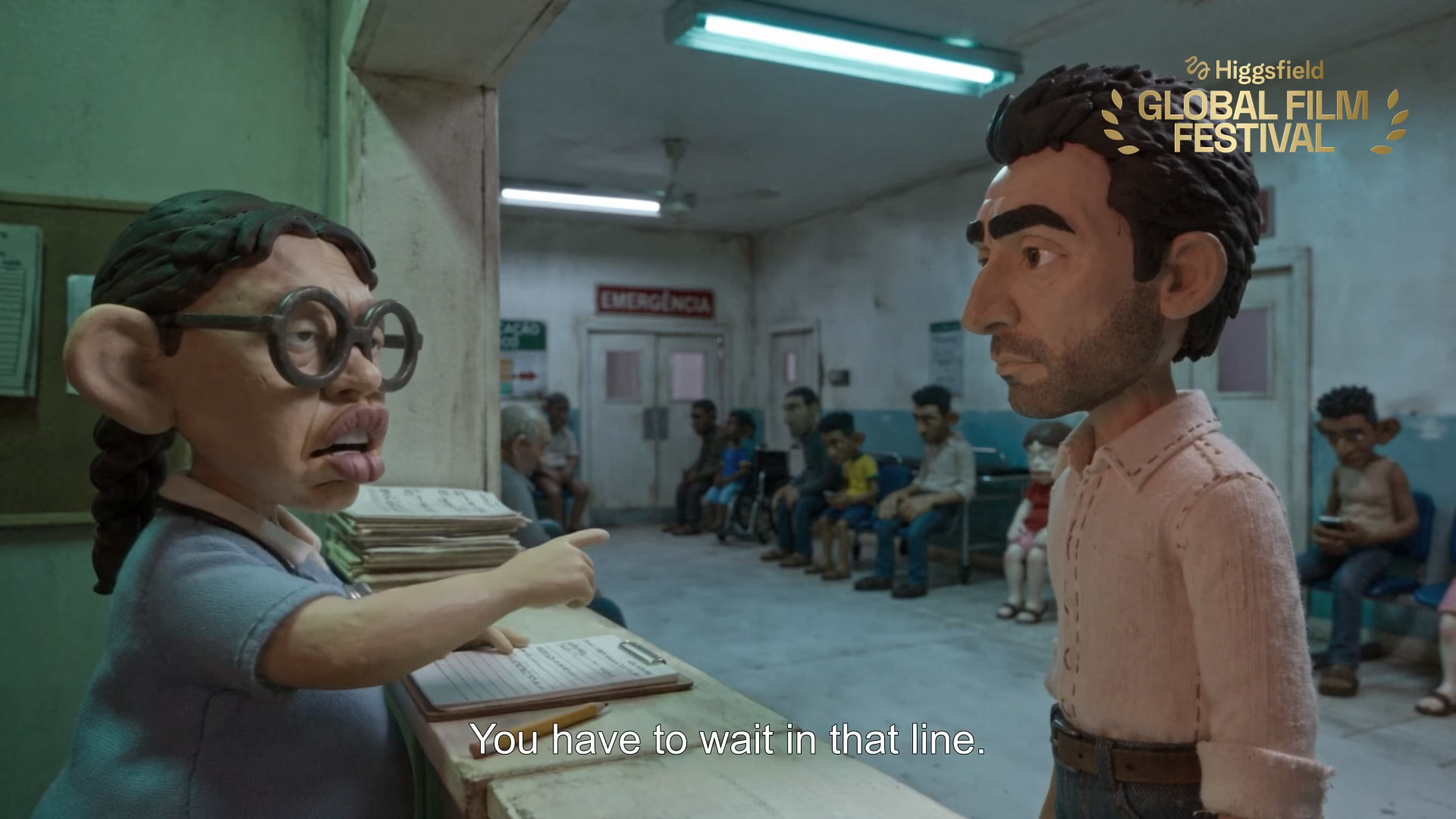
During an early hospital run, I went through 22 request versions across 11 plans without selecting a complete audiovisual scene. The problems included incorrect seating and support relationships, invented patients, reframing, and missing intended spoken performance. The image shows the scene in the later film.
The requests themselves exposed part of the mismatch. Audio generation was enabled, but structured dialogue lists were empty, and many prompts asked for no intelligible words. Those requests could prepare ambience and visual coverage while leaving the exchange at the heart of the scene unresolved.
My lesson from that early run is to test the central exchange before expanding coverage. The characters could look recognizable while the scene still failed to explain who understood whom and why the response mattered.
A continuity problem that had a different solution
At an opening A-to-B join, the image geometry jumped between clips. The successful retained proof applied a constant affine correction to the second clip and the same small crop and resize to both. I confirmed the reviewed comparison worked and asked to preserve the exact recipe.
The eight-second demonstration places the original join on the left and the corrected join on the right. The cut occurs two seconds into the comparison. Follow the window and fixed background features rather than only the character.
A single transform can correct a small global mismatch, but cannot repair incompatible foreground and background motion, changing perspective, missing contact, or reconstructed geometry.
I would not reuse that transform blindly on another pair of clips. It depended on the landmarks in this join, and the crop had a cost: losing a hand or signing space would damage the performance even if the background aligned.
8. How I worked with agents
I worked with agents on writing, reference preparation, technical checks, Blender scripting, audio experiments, and Resolve operations. I still had to direct the work: decide what the story meant, choose candidates, approve cameras, listen to the results, and reject material that did not work.
The project separated specialist responsibilities. Prompt work started from the scene’s existing baseline. Blender work owned a specific source and camera or layout change. Resolve work targeted a named working timeline. The coordinating agent connected those tasks, collected their outputs, and brought the result back for review.
The useful handoff contained the source, objective, permitted changes, protected decisions, expected output, and review criteria. For example: use this Blender version; preserve the camera; add these video cards; start playback when each enters view; return a new file and preview. That is much easier to judge than an open request to improve the ending.
The later board-lighting task shows the chain in concrete terms. It named the existing board-gloss-full-v02.blend, a matching source hash, a narrowly scoped Python change, and a new board-warm-match-v03.blend output. The change warmed the light and prepared the opening-frame match while preserving the camera, layout, and my drawings. The execution produced the editable file, a still preview, structured reports, and a 50-second render. That packet then supplied the Resolve handoff. The useful deliverable was the connected source and result, not merely an agent message saying the task was done.
The requests told me what an operation was meant to do; receipts and hashes connected it to exact outputs. That made a technical failure traceable. Choosing the result still depended on watching and listening.
The operations suited to automation were the bounded, repeated ones: naming outputs, extracting review frames, listing sources, and rendering a known scene. I still had to explain the creative decision. More tracking would not have solved an unclear direction.
9. Finding voices that could carry the performance
Voice work became one of the clearest examples of a technically successful output failing the scene. Correct words were only part of it; I also needed identity, acting, pronunciation, and timing to work together.
I tried Qwen3-TTS, Chatterbox, ElevenLabs, VoxCPM2, and Kokoro, and also used Gemini through Google AI Studio for narration. These tools entered the process at different stages: creating a voice, carrying an existing voice into new lines, or generating dialogue and background reactions.
| Tool or route | What I tried with it |
|---|---|
| Google AI Studio / Gemini | Generated narration. |
| Qwen3-TTS VoiceDesign | Described fictional voices and auditioned age, timbre, accent, and delivery. |
| Qwen3-TTS Base and VoxCPM2 | Generated new lines using an existing generated voice as a reference. Identity still had to survive the change of text. |
| Chatterbox and Kokoro | Tested short Portuguese dialogue for the passerby after the accident. |
| ElevenLabs | Tried hospital staff and waiting-room voices, with separate checks for identity, words, and performance. |
This was a set of experiments with different jobs. A voice selected as a reference could still produce a later take that I rejected. The listening examples retain those separate decisions.
Correct words, wrong performance
A line’s purpose mattered as much as its wording. Reassurance, pressure, hesitation, and reflection needed different pauses and emphasis, even when the text itself was already settled.
Those experiments led to the review sequence I would keep for future voice work. Automatic speech recognition (ASR) can transcribe a candidate and flag wording for inspection; it cannot decide whether the performance works:
- Preserve the native take
Keep the original file and exact script line; check that the file decodes.
- Listen and compare
Check words, identity, acting, and pronunciation. Use ASR only to flag possible wording errors.
- Select or revise
Record the decision. If the take fails, correct the performance or source before editing.
- Edit a derivative
Keep the source intact. Check phrase joins, timing, and intelligibility in the scene.
A reference I selected, followed by auditions I rejected
For one Qwen VoiceDesign test, I described a fictional mature woman with a warm mezzo timbre, a subtle Brazilian accent, and the feeling of sharing a personal memory. I selected this result as a voice reference for further variations.
Selected voice reference — Qwen3-TTS VoiceDesign · 15.5 seconds
“It’s curious to think about the moment that changed our lives. What sparked something in us and helped shape who we are. When I think about it, I find myself back on that day.”
A later audition used a shorter question. I wanted quiet, fully voiced speech, a small hesitation, and an unresolved ending. Qwen generated a voice from a description; VoxCPM2 used the earlier generated voice as a reference. These two samples share the text but use different routes, so they document my search for a performance rather than a controlled model benchmark.
Rejected audition — Qwen3-TTS VoiceDesign · 7.9 seconds
Rejected audition — VoxCPM2 · 6.9 seconds
I rejected that audition batch for artificial, weak delivery and too little distinction between the voices. EQ variants did not solve the complaint. The complete takes are preserved here as compressed listening copies, without retiming, pitch shifting, or gain processing; neither rejected take was marked as used in the timeline.
The same distinction appeared in another test: three direct-clone candidates matched the requested words in ASR, but I rejected their acting. Correct transcription gave me a wording check, not the emotional delivery I needed.
The installed Qwen Base route did not support a free-form acting instruction. That was a practical limitation of the route used in this project. If the performance was unsuitable, the next step was to obtain an appropriate performed guide or try a separately evaluated route, rather than assuming another adjective in the request could control the delivery.
Repairing a phrase inside an existing take
A phrase correction preserved most of one take and replaced the problematic opening phrase. The repaired transcript matched the requested wording. At that stage, its record still listed listening, scene assignment, and source-rights clearance as unresolved, with no timeline use recorded. This repair experiment does not establish which voices appear in the submitted soundtrack.
The distinction was between a local wording problem and a performance problem. Replacing a phrase could address the first. EQ, pitch shifts, or removing silence could not reliably supply acting that the take never had.
A phrase repair also created a new listening problem at the splice. ASR word timestamps did not establish a safe boundary through continuous speech. A click-free join could still change the room, tone, or intention halfway through a thought.
The source, performed guide, candidate, and edited derivative had different roles. Keeping those relationships legible was especially important when a conversion sounded plausible but changed a word.
The separate question of language and signing
Portuguese was the main spoken language; English subtitles were part of the intended delivery. The story also involved Libras and later multilingual material. A generated voice that sounds fluent to a non-speaker cannot establish correct wording or performance.
Signing requires more than recognizable hand motion. Handshape, orientation, direction, signing space, shoulders, and facial grammar all contribute. The project records approval of one hand-motion candidate, but that does not establish full linguistic correctness across the film.
For another production, I would include a fluent reviewer earlier in the performance loop. I would also protect the hands and face in the framing and define the resting action after a signed phrase. The approval of one hand-motion candidate did not settle those wider language questions.
10. Building the soundtrack one scene at a time
The sound plan was organized by what the audience needed to hear, not by adding a large soundtrack file to every clip. Dialogue, narration, ambience, object sounds, movement, reactions, and music had different jobs.
The project used “Foley” as a folder and cue label for synchronized movement and object sounds. The examples here were generated sound-effect sources, rather than recordings of a Foley artist performing those actions against picture.
The SFX preparation distinguished story-critical sounds from tactile detail. An engine approach, horn, brake, and restrained impact establish the accident differently from a single combined cinematic crash. Keeping them separate lets the edit control anticipation, distance, timing, and how much of the event is heard.
| Layer | ISA examples | What to decide before placement |
|---|---|---|
| Ambience | Street, hospital, library, turtle center, travel locations | Which place are we in, how occupied is it, and what perspective does the shot imply? |
| Foley and objects | Glass wipes, stroller wheels, clothing, paper, books, boxes, trays | Is the action visible or otherwise motivated, and what material makes the sound? |
| Reactions and background voices | Breath, effort, concern, indistinct crowd texture | Does it support the scene without inventing a new intelligible conversation? |
| Dialogue and narration | Scene exchanges and reflective passages | Which words must remain clear, and where is room needed for a pause? |
| Music | Everyday warmth, tension, sadness, later continuation | What changes emotionally, and where should the score yield to the action? |
Mapping sounds to visible actions
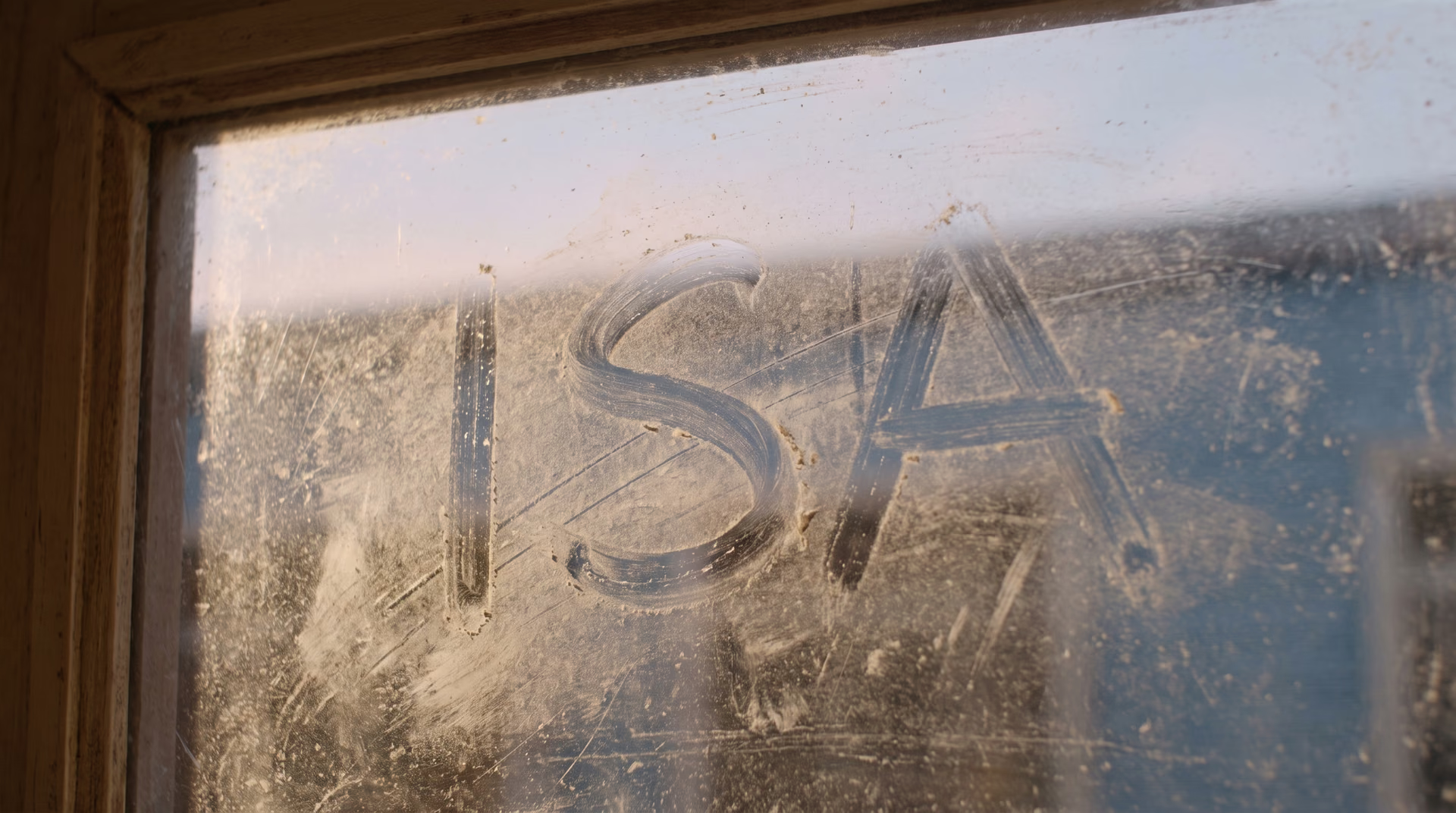
The project mapped sounds to visual cues before picture lock. For the opening, that included dry palm movement on dusty glass, footsteps, light clothing, and stroller movement. The lettering already existed on the glass, so there was no reason to invent a title-writing sound.
The hospital used separate room and pressure elements: fan, fluorescent hum, paper, wheels, footsteps, and indistinct voices. They could accumulate or recede around the interaction. Signing itself did not need a special sound effect; only motivated clothing and contact sounds belonged there.
Later scenes had their own materials. The library called for books sliding, cardboard flexing, boxes settling, and a working rhythm. Turtle-care preparation called for delicate brush friction and support-surface contact, rather than invented animal vocalizations or exaggerated scrubbing.
The opening and early hospital batches included approved sounds; other batches remained candidates. A picture change could invalidate an effect’s timing or purpose, even after the source itself had been approved.
Auditioning individual sound sources
Local audio work recorded 24 Stable Audio 3 Small-Music outputs, 77 Small-SFX outputs, and four video-conditioned MMAudio outputs. ISA used a CUDA workflow; a new production can use any suitable licensed source, recording, or generation route.
The acoustic brief described a sound the model could produce: its source, material, distance, rhythm, environment, and unwanted additions. One Maldives candidate requested gentle above-water shoreline surf, with successive waves and sandy hiss. It was generated as a twenty-second native PCM24 audition, without music or speech. A hospital clock correction requested a close, heavy tick-tock with clear silence between the knocks. These were isolated sources awaiting listening, not finished loops or automatically selected soundtrack elements.
The opening glass wipe provides a complete example of source preparation. The request described one bare hand moving slowly across dusty glass, with dry skin friction, a clear beginning and natural finish, and no water spray, speech, or music. Stable Audio produced a five-second stereo WAV at 44.1 kHz and 24-bit depth. I listened and approved it as a sound effect; its file identity, generation record, and intended scenes stayed attached to that decision.
Waveform analysis suggested a provisional audition window. ASR also returned a possible word from the non-speech sound, so that result needed listening rather than automatic acceptance. The usable interval still needed alignment to the hand contact; my source approval did not establish its final placement.
Three ninety-second hospital-pressure studies explored cello/viola pulse, acoustic guitar with bass and percussion, and repeating low piano with strings. Their briefs set instrumentation, tempo, density, mood, and an unresolved ending. Different prompts and seeds explored directions; listening and picture alignment remained pending.
I rejected the first opening theme because it needed a more Brazilian direction. The choro revision then produced strange or broken musical sounds whose cause was unresolved. Eighteen later studies used shorter prompts and varied seeds but still awaited listening. Those later files therefore remained candidates, not a resolved opening score.
The handoff into editing kept the native file, scene/role, source identity, duration, and candidate status together. The editor still needed to audition it against picture, identify the usable range, and decide whether it supported the action. If an ambience might loop, its join needed a separate listening check. If a video already carried usable sound, adding another generated layer could duplicate it. Any trimmed, faded, or resampled editing copy needed to remain distinguishable from the native source.
Making room for silence
The sound plan contained intentional silence, including a specific pause around the family response after the accident. Filling every gap with movement sounds or music would change that choice. A cue marked “reserve” was available if the selected picture needed it; it was not an instruction to place it regardless.
The planned silence made me think about transitions as sound decisions too. A bridge can connect two places; a habitual whoosh can cover up the pause the story needs. That is a principle I would carry forward, rather than a description of a specific finished ISA cue.
Moving from everyday warmth to the accident
One documented local music revision changed from an everyday theme into a sadder theme as the mother ran toward the collision. It used a two-second crossfade and reduced the music during the impact and first reaction. Later work also lowered music beneath voice passages.
I treated that two-second crossfade as a local solution to the mother’s approach and the collision. It was not a duration I could apply to every emotional transition; overlapping rhythms and themes changed how each join felt.
Later reviews caught unwanted music overlaps and called for more silence before the credits. Those complaints made the surrounding scene part of the review, rather than just the transition itself.
11. Bringing the film together in DaVinci Resolve
Resolve brought the separately produced material into a shared time axis. A candidate that worked by itself could fail beside the previous shot because the scale, direction, gaze, motion, light, or sound changed abruptly.
The editing experience left me with a preparation checklist for the next project: resolve offline media, inspect source frame rates, resolution, and color metadata, and establish timeline settings and technical color handling before grading. Mixed-rate footage deserves an early test because retiming or optical flow can alter the intended stepped motion.
The project used a full-film area and separate bins for each section. Standalone audio had its own organization for dialogue, narration, ambience, Foley/effects, and music. Media references were reused rather than reimported just to make a bin look tidier.
Section timelines and the full-film assembly
The workflow called for one designated working timeline per section. Superseded versions belonged in Previous_Versions. New work changed the individual media clips inside the current timeline; repeatedly nesting old timelines inside new ones would make source relationships and sound harder to follow.
Full-film assembly was a separate task. It combined the sections and the remaining narration or music while checking what audio their timelines already carried. Adding another copy of the same music at the full-film level could create an overlap that was not obvious from the picture edit.
Track names described function. Within each section, separate tracks helped organize dialogue, narration, ambience, effects, and music. In later feedback, I asked for the working mix to be simplified around music, narration, and effects. The aim was control over the sound, not a particular track count.
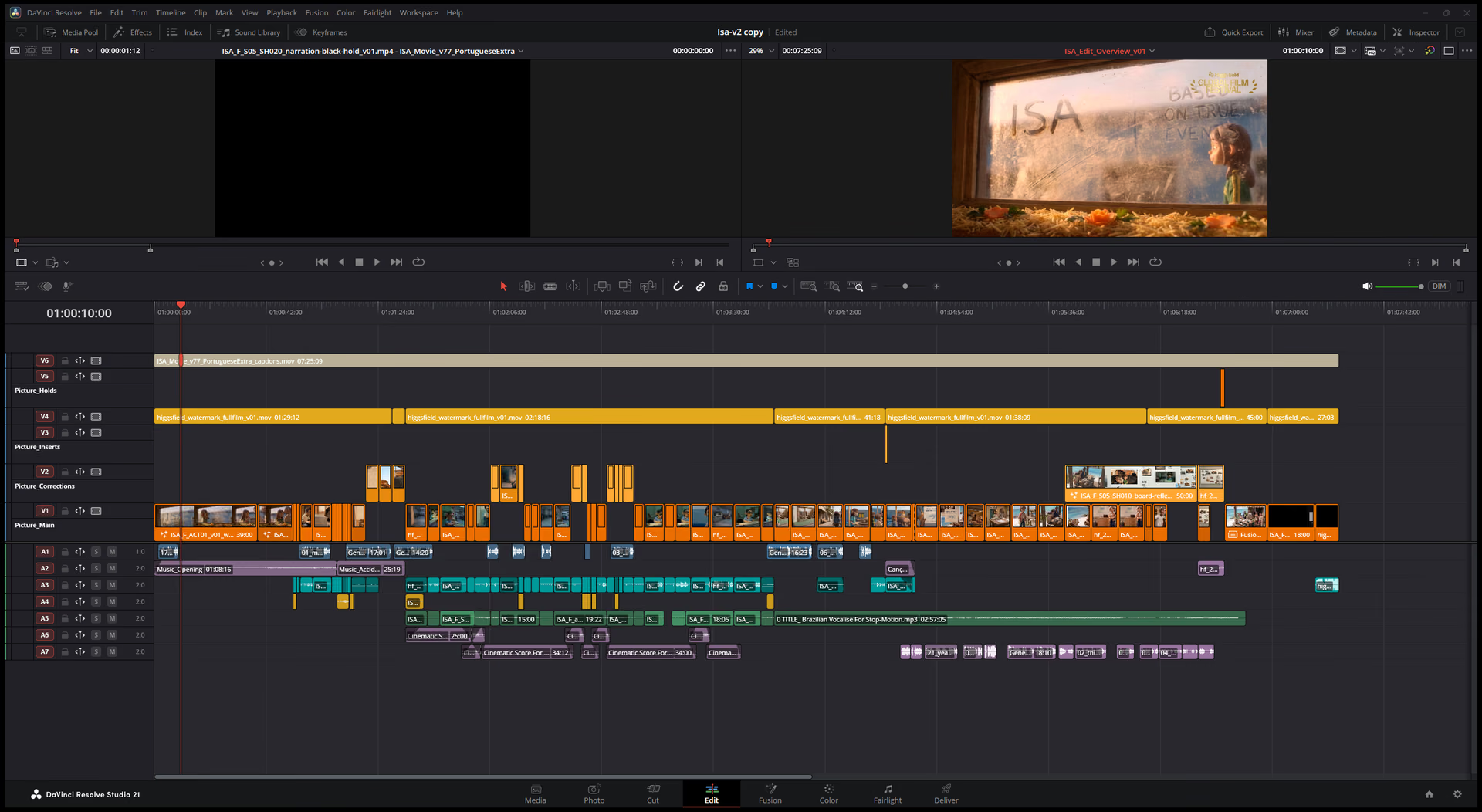
This later presentation capture illustrates separate picture and sound layers; it is not the exact submitted timeline.
Watching what happened across a cut
For a proposed cut, the project’s review method started with roughly the last two seconds of the outgoing shot and first two seconds of the next, including sound. The window could expand when a gesture, contact, camera move, or sound event crossed the boundary.
The comparison needed more than matching still frames. Character scale, screen direction, gaze, speed, contact, and sound perspective all affected whether the cut held together. A small visual difference could work when the dramatic action carried it; matching frames could still produce a jump in motion.
Checking the result of a scripted edit
Scripted Resolve work inspected the target project and timeline, made a versioned change, and read the affected state back. Changes to gain, transitions, or clip placement also needed a render or playback check. A successful operation response could not prove the viewer would see or hear the intended result.
A volume-control adapter mismatch required a small fixture test before further scripted audio edits. Checking the corrected control did not validate the full mix; the rendered changes still needed listening and measurement.
My later review notes called out overlapping music, narration level and delivery, hospital color, and missing subtitles. They were problems at specific moments in the film, so the neighboring shots mattered when judging a correction.
12. Turning earlier scenes into a wall of memories
The board ending was one late production decision within this larger process. Earlier, a board had been explored as a way to move between travel scenes: use entry and exit frames as photographs, then move the camera across them to connect memories.
The layout went through corrections. I asked for photographs at different heights so the camera could travel diagonally rather than follow a straight row. The early guide kept a country sequence through India, Egypt, and the Maldives.
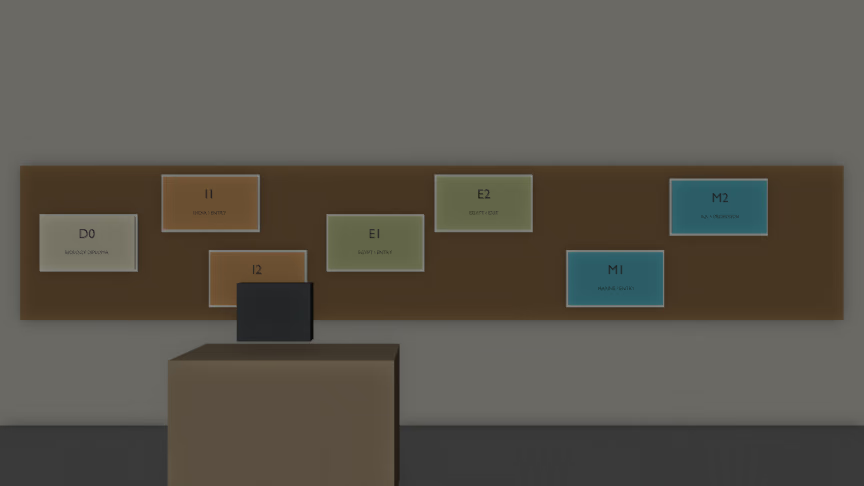
The early guide used placeholder cards, including a diploma idea later replaced. It fixed the route between photographs before final media bindings.
From a camera guide to a finished insert
I asked for the existing board to become a roughly 50-second film insert. It would no longer be only a guide for another generation. Blender would render a camera journey across images and videos already produced for ISA.
The method was effectively 2.5D: flat pictures and video textures arranged in a scene, with a perspective camera, paper borders, pins, lighting, and reflections. The generated people and actions were already inside those pictures. I did not need to build another character rig and animate a full classroom performance for this ending.
The later board contained 22 image plates, seven carrying video. The camera revisited parents, hospital, library, and travel scenes before revealing the entire wall.
Narration gave the camera its destinations
I mapped the passage about her parents to the father and children in the car, and the passage about learning from other people’s mistakes to the hospital attendant. The camera destinations had a narrative reason.
I asked for a scattered layout, slow left-to-right travel, longer video holds, and a nearly frontal final reveal. Later additions had to preserve that approved camera path.
The script estimated how much of each card was inside the frame using its projected bounding rectangle. Peripheral clips started at 25% coverage; featured clips waited for 85% and a near-center position. These were heuristics for this shot: they did not measure the true visible polygon or detect another card blocking it. Obstruction, legibility, and narration sync still required playback review.
A 48-frame material blend, two seconds at 24 fps, eased the surface between its photographic treatment and moving-image treatment. The sources played without looping. Two late clips still extended beyond the 50-second board boundary, so full source playback did not imply that every source frame appeared in the final sequence.
Finding the right amount of reflection
Reflection was a practical problem. Strong glare made the pictures pale. An early correction went too far toward an opaque, flat treatment. I asked for less whitening and a gentler reflective sheen.
The material revision kept the picture readable while preserving a photographic surface. I then added drawings to the board myself and requested a render of the saved scene. Those marks and varied pins made the composition more personal without replacing the existing camera work.
The demonstration uses three six-second selections at original speed: entering a photograph from the previous scene, a photograph playing as video, and the wider reveal. The two cuts are added for explanation; the source board render is continuous and 50 seconds long. This demonstration is silent.
Making the previous scene become a photograph
The later transition used the exact rendered endpoint of the preceding shot as the first photograph. Its mapping matched the opening camera view. Over two seconds, the material changed from the source image’s color to the glossy photograph; as the camera withdrew, the scene became a picture on the wall.
The lights were warmed while preserving the camera, layout, and drawings. That render was inserted into a working Resolve timeline and a later edit faded the board into credits. The relevant edit records still marked continuous author playback review as pending.
The board worked as an approach because the ending revisited existing moments. I already had the images and performances it needed. It would not have solved a new interaction or signed conversation; those would still require their own acting.
13. Subtitles, credits, and the submitted version
Finishing required a specific film version, its sound, captions, credits, and delivery materials to agree. “The latest export” was not enough to identify what had been shared or submitted.
The project had distinct release moments. A work-in-progress version of the opening section was published first. A later v48 export was associated with a separate compression and YouTube distribution step. The submitted film was identified as v76. A Portuguese v77 extra was a later derivative, not a replacement identity for the submitted file.
Designing the last sequence
ISA’s credit work included disclosure, a technology message, creator/contact information, a combined technical card, and the closing packshot. I removed some earlier cards and combined others instead of letting the ending become a long list of production details. One documented combined composition was held for sixteen seconds; that was a design decision for its amount of information, not a rule for every credit card.
The visual treatment kept a dark central reading area and used selected travel images softly near the edges. The images supported the text without replacing its reading space. A later typography correction aligned the three-line message and smaller closing on the same left edge. The design records preserve sampled composition checks while leaving full-motion taste and music review open.
The technical credits used an earlier effort estimate. The later closeout revised that accounting; the two snapshots should not be presented as the same measurement.
What I would carry forward is to settle the credit text before designing its cards, then judge reading time against the music and transitions. My request for more silence before ISA’s credit music came from that same concern: the ending still needed pacing.
Missing subtitles and the limits of a timeline check
The intended workflow used English subtitles burned into the picture after picture lock. Meaningful spoken and signed lines needed access for the audience. Subtitle wording, synchronization, visibility, line breaks, and relation to the performance are separate checks.
During editing I reported missing subtitles. A later structural check found 16 English caption clips in a source copy, but their presence alone did not establish that every caption was visible, correct, or synchronized in the submitted export. A timeline inspection and a rendered-film review answer different questions.
For the next film, I would make a complete subtitle pass on the delivery render after the last picture change. That would include cue boundaries, names, language changes, and any text covering hands or important action. A correct timeline entry is not enough to establish what an audience sees.
Identifying the submitted export
The delivery checks I would use for another export are:
- Verify duration, resolution, frame rate, audio format, sample rate, and channel layout against the delivery specification.
- Measure the exported mix’s loudness and true peak against that destination’s requirements; check for clipping. Do not apply one universal LUFS target or normalize every clip independently as a substitute for mixing.
- Watch and listen from beginning to end, including transitions between sections, quiet passages, subtitles, credits, and required branding. Recheck any new export after a correction.
Blackmagic’s Resolve training guide distinguishes loudness and peak controls; the destination determines the required targets. I do not have a retained measurement establishing ISA’s final audio levels, so these remain recommendations for the next delivery.
The submitted version was v76, running approximately 7 minutes 25 seconds. I kept its file identity in the closeout so I could distinguish it from earlier exports and later language variants.
The different exports made exact version names necessary. The submitted film, a language variant, and a compressed distribution copy could not all share an ambiguous “final” label. Their relationship to the editable timeline and subtitle source mattered too.
14. What I kept for future revisions
Keeping the viewing copy was only one part of preserving the project. Revising it later would require the source media and an editable assembly that could find those files.
The retained ISA material included story documents, scene-owned prompts and media, shared assets, audio, Blender scenes, Resolve project/timeline exports, generation records, and earlier review exports. The approved continuity-repair proof also kept its recipe and exact sources so that particular correction could be reproduced.
Resolve .drp project exports and .drt timeline exports preserve editable structure and need the corresponding media. I preserved a v76-related editable snapshot before making the Portuguese derivative, but the closeout included no verified restoration test.
Working directories also mattered: something that looked temporary could contain unique media or a render still referenced by the edit. Earlier attempts could explain how I reached a selected result, which made indiscriminate cleanup risky.
For the next archive, I would restore a separate copy and confirm that it uses the copied media:
- Collect the dependencies
Include Resolve exports and media, Blender scenes, textures, video textures, audio, and required fonts or linked assets.
- Restore a separate copy
Open it as a test project and relink to the copied media. Keep the original workspace intact.
- Verify resolved paths
Inspect Resolve and Blender paths. Confirm the test uses the restored package rather than the original files.
- Render and compare
Check missing media, appearance, timing, and sound in a representative segment. Record unresolved dependencies.
Blender’s packed-data documentation also cautions that some external media cannot be packed into a .blend; preserve those files alongside the scene.
15. What the production actually involved
The closeout production record counted successful model outputs as follows:
| Output category | Recorded outputs | Examples included |
|---|---|---|
| Images | 115 | Design, references, scene candidates |
| Video | 32 | Locally registered generated clips |
| Music | 24 | Score candidates |
| SFX, ambience, and video-conditioned sound | 81 | Effects, environmental layers, and sound derived from video |
| Voice, dialogue, reaction, and walla | 163 | Narration/dialogue tests, reactions, background voices |
| Total | 415 | Outputs across candidates, not final-film assets |
Another 26 local audio derivatives and six failed or supplied entries bring the record count to 447. Outputs, receipts, stored files, and selected film assets are different units.
The provider inventory separately showed 1,009 materials. Its coverage differs from the local records, so the inventories cannot be added together; the 32 locally registered videos are not a complete provider-wide count.
The broader workspace inventory covered roughly 71.12 GB and 80,449 files, including caches and technical working areas. That was the storage footprint, not a creative-asset count.
Time and money had different measurement boundaries
The closeout recorded 106.44 net foreground hours across 39 production days, removing inactivity and overlapping tracked intervals. My broader 212.88-hour figure used a personal net × 2 convention; it was not an independent measurement or a multiplier to reuse for another budget.
The declared US$320 covered Higgsfield and ChatGPT Pro subscriptions. It did not include labor, hardware, electricity, or taxes. It should not be read as a repeatable quote for producing a similar film.
Generation was only one part of the work. Review, repair, listening, version management, integration, and rendering also consumed time. Those are the parts I would account for separately when estimating another film.
16. What I would carry into the next film
I would test the hardest story-critical actions early, before building more scenes around them. If repeated attempts failed, I would set a limit on further tests and look for another way to communicate the same story point. That would leave more of the budget for finishing the film.
I would start a smaller film with fewer tools and keep the responsibilities that proved useful: story, references, scene work, sound, editing, and selected exports. This is a proposed simplified structure, not ISA’s historical folder tree:
MyFilm/
  Story/
    screenplay.md
    visual-direction.md
  References/
    Characters/
    Locations/
  Scenes/
    S01_SH010/
      scene.md
      Prompts/
      Previs/
      Candidates/
      Selected/
  Audio/
    Dialogue/
    Narration/
    Ambience/
    Foley/
    Music/
  Edit/
    Backups/
  Exports/
    Review/
    Delivery/
In that smaller setup, shared references would stay in one place, scene-specific prompts and review notes would stay with the scene, and sound would remain independently editable. Review exports and delivery files would have separate destinations.
The scene information I would keep
This is the scene worksheet I would carry between tools, distilled from the information the ISA requests and reviews needed:
| Field | What to record |
|---|---|
| Scene and version | Stable ID, current candidate, and date of the decision |
| Story purpose | What changes for the character or audience |
| Initial and final state | Where people and objects begin and where the action must end |
| Cast and location | Exact references and what each one controls |
| Action | A short causal sequence, including contact and response |
| Camera | Framing, movement, visibility requirements, and protected geography |
| Dialogue or signing | Canonical wording/meaning, performance reference, required reviewer |
| Sound | Ambience, events, music intention, and deliberate silence |
| Source files | Original identities, selected ranges, and derivative relationships |
| Review result | What worked, what failed, and what the next attempt may change |
The café request illustrates the worksheet. Its cast and camera direction were reviewed; the generated take still needed its own decision.
| Field | Café example |
|---|---|
| Scene and version | S01_SH030, café-family request v02 |
| Story purpose | Establish an absorbed family interaction before the offscreen disruption |
| Cast and location | One family reference containing four distinct people; a separate location image controls architecture and daylight, not incidental people |
| Action | 0–2 seconds: father plays with the daughters; 2–7: gestures and laughter build; 7–10: sustain the interaction, without noticing the mother offscreen |
| Camera | Locked medium framing, all four at the table near the threshold |
| Sound and review | Ambience, laughter, and Foley; no intelligible speech. Cast and camera direction reviewed; generated performance still needs its own decision |
The feedback I would keep is observable and bounded: for example, “delay the child’s approach until the adult looks up; preserve the camera.” I would also distinguish approval of a composition from approval of the complete shot.
A demanding scene as the first complete test
I would take one demanding scene through picture, sound, and edit before scaling up the next film. The early hospital attempts showed why: a believable image did not resolve the exchange at the center of the scene. That first test would target the largest uncertainty, whether interaction, signing, voice, or continuity.
I would reuse the stable references, naming, scene records, and review criteria, while allowing the shot method to change. The café, hospital, turtle study, and memory board needed different kinds of preparation.
What I would review first
The review order I would carry forward begins with meaning, action, geography, identity, and performance, including the sound needed to understand them. Continuity, lighting, and surface detail then have something solid to refine. The last check belongs to the complete delivery render, with its captions and credits.
If you are planning a similar production, send the story, current material, and the stage that needs help. I provide AI and workflow support and technical production support for teams connecting art, tools, and delivery.


Project context
Bring production context into the next character brief.
A useful project conversation connects visual goals with constraints, role, pipeline expectations, and delivery proof.